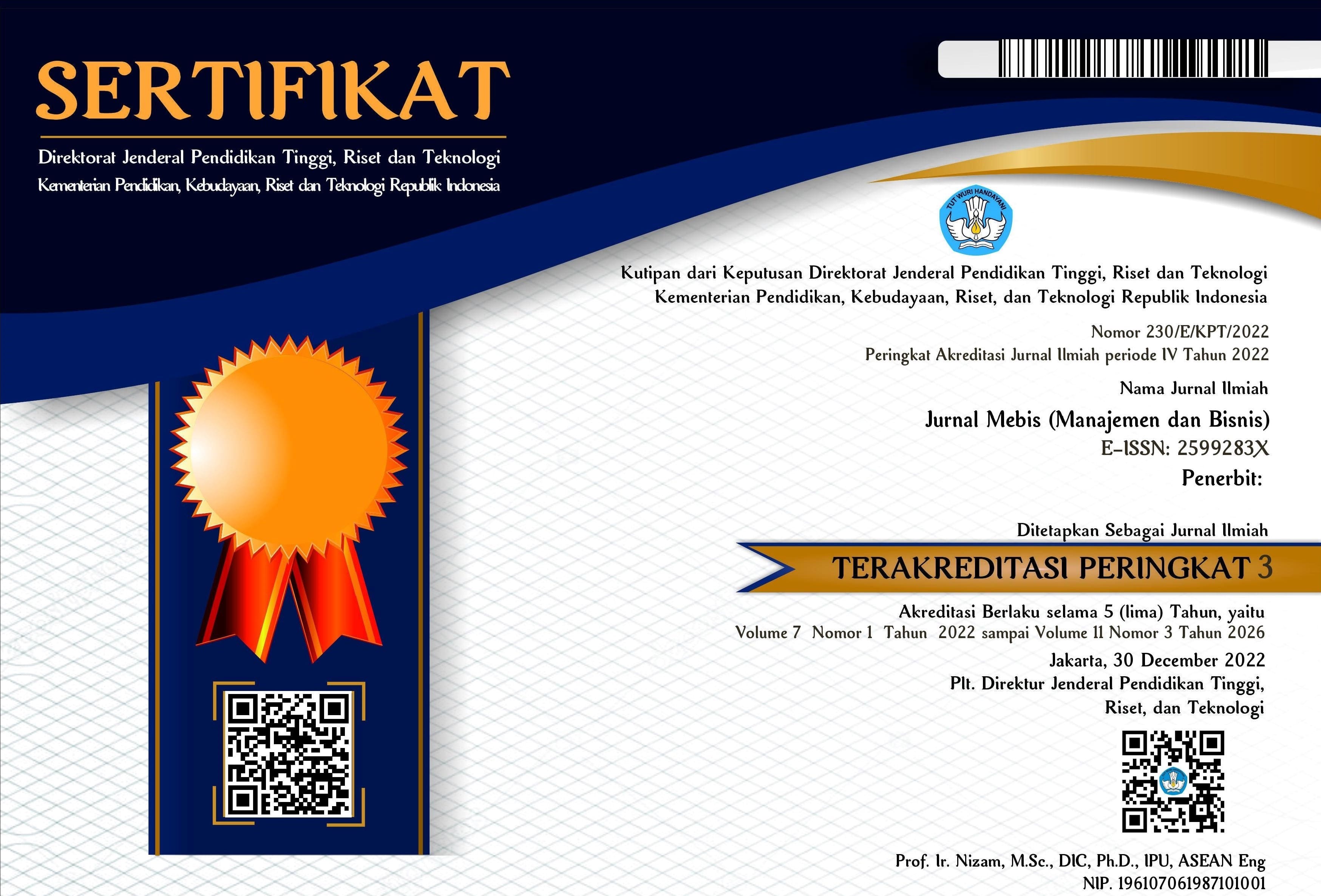
The Analysis of Customer Loyalty to Takeaway Restaurants in The Special Region of Yogyakarta
DOI:
https://doi.org/10.33005/mebis.v10i2.741Keywords:
Service Quality, Product Innovation, Customer Satisfaction, Customer loyaltyAbstract
The rapid advancement of technology and information has significantly impacted various sectors, including the food and beverage industry. As a fundamental human need, food plays a crucial role, and the increasing demand has led to substantial growth in this sector, particularly in restaurants and eateries. According to data from the Ministry of Industry (2023), the food and beverage industry grew by 5.35% in the first quarter of 2023, making it a major contributor to the non-oil and gas processing Gross Domestic Product (GDP). This study investigates the effects of service quality, product innovation, and customer satisfaction on customer loyalty at Takeaway Restaurants in the Special Region of Yogyakarta. Given the increasing competition in the food and beverage industry, understanding these factors is essential for maintaining a loyal customer base. Utilising a quantitative approach, data were collected from 123 repeat customers through online surveys administered via Google Forms. Using the SPSS analysis tool, IBM SPSS 23 Software version. The results indicate that all three variables significantly influence customer loyalty, with service quality having the most substantial impact. The findings highlight the importance of exceeding customer expectations through high-quality service and innovative product offerings. Additionally, recent challenges, such as concerns over hygiene practices, underscore the need for immediate improvements in service standards. Recommendations for Takeaway Restaurants include enhancing staff training, ensuring cleanliness, and fostering a positive dining experience to build long-term loyalty.
Downloads
References
Chlorella Tama, E., & Siagian, M. (2024). Pengaruh Digital Marketing, Variasi Produk Dan Inovasi Produk terhadap Loyalitas Pelanggan pada Board Games Cafe Batam. SEIKO : Journal of Management & Business, 7(1), 859–868.
Dekrityawa, R., & Budiyanto, B. (2023). Pengaruh Service Quality, Customer Satisfaction, dan Brand Image Terhadap Customer Loyalty (Studi Pada Kedai Serlok Kopi Cabang Mulyosari Surabaya). Jurnal Ilmu Dan Riset Manajemen (JIRM), 12(7), 1–17.
Esha, Dian. Pratama, P. (2021). Pengaruh Inovasi Produk, Fasilitas, dan Kualitas Pelayanan Terhadap Loyalitas Pelanggan Roti Bakar 88 Kutabumi Tangerang. Jurnal Manajemen Bisnis, 1(2), 47–56. non-dwnldmngr-download-dont-retry2download
Hair, J. F., Hult, G. T., Ringle, C., & Sarstedt, M. (2017). A Primer on Partial Least Squares Structural Equation Modeling (PLS-SEM) - Joseph F. Hair, Jr., G. Tomas M. Hult, Christian Ringle, Marko Sarstedt. In Sage.
Kementerian Perindustrian. (2023). Kemenperin Mendorong Ekspansi Industri Makanan dan Minuman ke Pasar Global. 27 Juli 2023. https://kemenperin.go.id/artikel/24213/Kemenperin-Mendorong-Ekspansi-Industri-Makanan-dan-Minuman-ke-Pasar-Global.%0A
Kotler, P., & Armstrong, G. (2018). (2018). Principles of marketing. In Early Greek Mythography, Vol. 1: Texts (17th [edit). Pearson Higher Education. https://doi.org/10.1093/oseo/instance.00295839
Kotler, Philip. Keller, K. (2016). Marketing Management. In Pearson Education © (16th editi, Vol. 15e). Pearson Education.
Kotler, P. (2003). Marketing Management. In New Jersey: Prentice Hall. (7th ed.).
Kotler, P., & Keller, K. L. (2009). Marketing Management. Edin Brugh: Pearson, e13(2009), 6–25.
Kurniawan, R., & Auva, M. A. (2022). Analisis Pengaruh Kepuasan, Kualitas layanan, dan Nilai Harga Terhadap Loyalitas Pelanggan pada Restoran Seafood di Kota Batam. Jesya, 5(2), 1479–1489. https://doi.org/10.36778/jesya.v5i2.711
Lovelock, C., & Wright, L. (2005). Manajemen Pemasaran Jasa. PT. Indeks Kelompok Gramedia. https://scholar.google.com/scholar?hl=en&as_sdt=2005& sciodt=2007&cites=6214862132167984168&scipsc=&q=Lovelock%2C+C.+H.%2C+%26+Wright%2C+L.+K.+%282005%29.+Manajemen+Pemasaran+Jasa.+Jakarta%3A+Indeks.&btnG=
Lukas, B. A., & Ferrell, O. C. (2000). The Effect of Market Orientation on Product Innovation. Journal of the Academy of Marketing Science, 28(2), 239–247. https://doi.org/10.1177/0092070300282005
Makmur & Thahier, R. (2015). Inovasi dan Kreativitas Manusia dalam Administrasi dan Manajemen. Bandung: Penerbit Refika Aditama. Penerbit Refika Aditama.
Oliver, R. L. (1997). Satisfaction: A Behavioural Perspective on the Customer (Vol. 17). New York: The McGraw-Hill Companies, Inc.
Rorim Panday, M. F. N. (2024). The Effect of Service Quality and Consumer Satisfaction on Customer Loyalty. Jurnal Ilmiah Manajemen Kesatuan, 12(6), 2759–2770. https://doi.org/10.37641/jimkes.v12i6.3221
Setiadi. (2010). Perilaku Konsumen (Cetakan 4.). Kencana.
Sisca, S., Simarmata, H. M. P., Grace, E., Purba, B., Dewi, I. K., Silalahi, M., & Sudarmanto. (2021). Manajemen Inovasi. Yayasan Kita Menulis.
Tjiptono, F. (2008). Service Management. Andi Offset.
Tjiptono, F. (2014). Pemasaran Jasa: Prinsip, Penerapan, Penelitian.
Tjiptono, F. (2019). Service , Quality & Satisfaction.
Tjiptono, F. (2020). Pemasaran Jasa (1st ed.). Yogyakarta: Andi Offset. (1st ed.).
Zeithaml, V. A., Bitner, M. J., & Gremler, D. D. (2010). Services Marketing Strategy. Wiley International Encyclopedia of Marketing, December. https://doi.org/10.1002/9781444316568.wiem01055