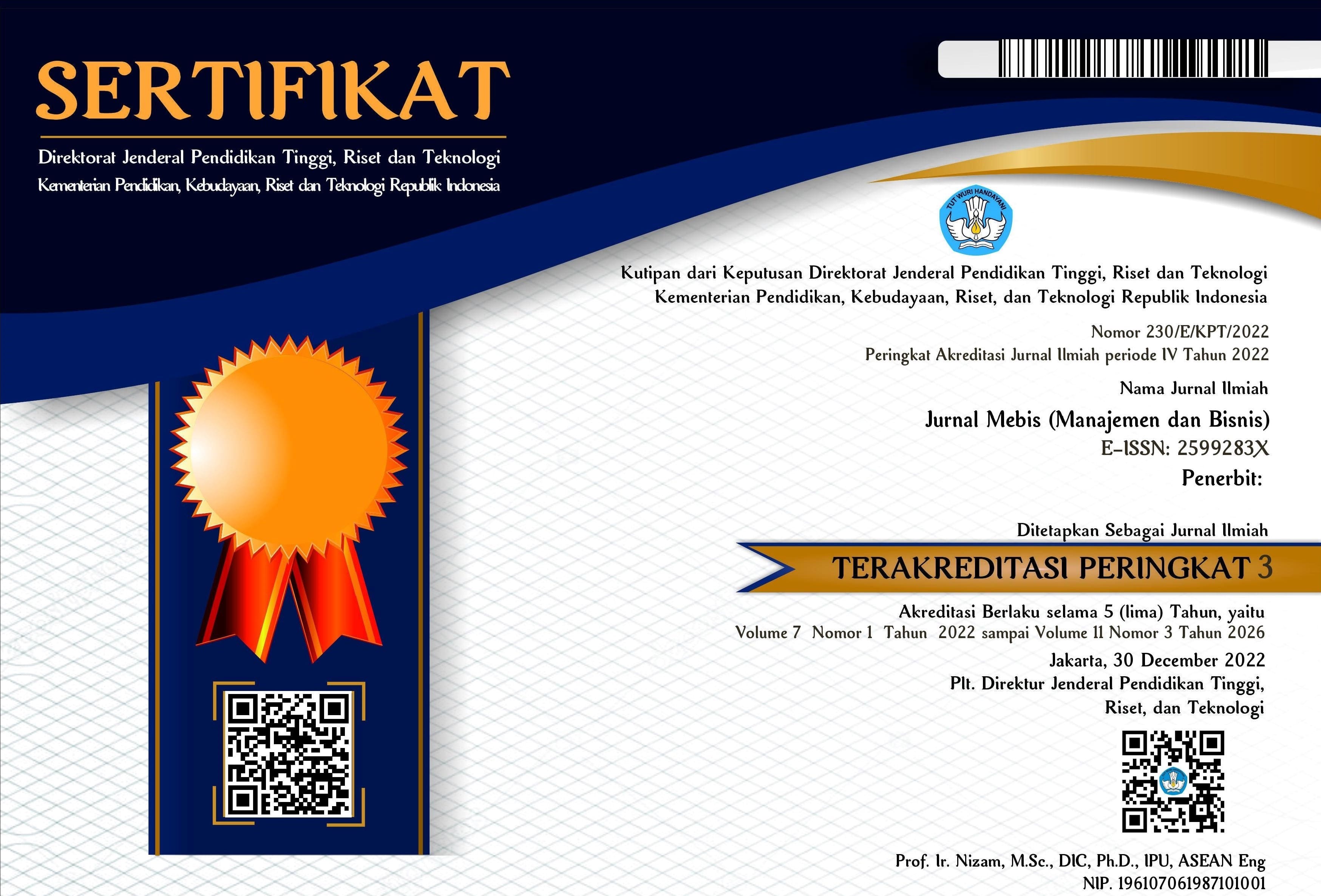
Optimizing Digital Marketing Strategy through Influencer Credibility, Content Quality, and Electronic Word of Mouth (E-WOM) in Building Customer Trust and Increasing Purchasing Decisions (Study on Erigo Fashion Brand in Makassar City)
DOI:
https://doi.org/10.33005/mebis.v11i1.750Keywords:
Influencer Credibility, Content Quality, Electronic Word of Mouth (E-WOM), Customer Trust, Purchase DecisionAbstract
This study analyzes the influence of Influencer Credibility, Content Quality, and Electronic Word of Mouth (e-WOM) on Customer Trust and their impact on Purchase Decisions for the Erigo fashion brand on the TikTok platform. This study employs a quantitative approach using the accidental sampling method, where respondents consist of consumers who have purchased Erigo products through TikTok. A total of 125 respondents participated in this study. Data were collected through online questionnaires and analyzed using the Partial Least Squares (PLS) method with SmartPLS 3 software. The results show that Influencer Credibility, Content Quality, and e-WOM have a positive and significant effect on Customer Trust. Additionally, Influencer Credibility has a positive and significant direct effect on Purchase Decisions, while Content Quality and e-WOM have positive but not significant direct effects. However, both variables demonstrate significant indirect effects on Purchase Decisions through Customer Trust as a mediating variable. These findings highlight that Customer Trust plays a crucial mediating role in linking digital marketing strategies to consumer purchasing behavior. Therefore, fashion brands such as Erigo should strengthen influencer credibility, enhance the quality of promotional content, and optimize positive e-WOM to build consumer trust that drives purchase decisions on TikTok.
Downloads
References
Akhmad, N. A., & Wijaya, S. R. (2023). Influencer marketing dan online customer review terhadap minat beli produk fashion di Tiktok Shop. Jurnal Administrasi Bisnis (JAB), 12(3), 215–229. https://ejournal.unsrat.ac.id/index.php/jab/article/view/58716
Alamsyah, R., & Sutanto, H. (2024). The influence of trust in mediating E-WOM and social media usage toward purchase decision involvement at TikTok. Telkom University Open Library. https://openlibrary.telkomuniversity.ac.id/pustaka/files/236347/jurnal_eproc/the-influence-of-trust-in-mediating-e-wom-and-social-media-usage-toward-purchase-decision-involvement-at-tiktok.pdf
Ariyani, R., & Mulyana, D. (2024). The role of influencer marketing and online customer review on brand attitude in increasing brand loyalty, brand awareness, and purchase intention in fashion brands in Indonesia. Jurnal Syntax Literate: Jurnal Ilmiah Indonesia, 9(6), 1023–1038. https://jurnal.syntaxliterate.co.id/index.php/syntax-literate/article/view/55821
Ashley, C., & Tuten, T. (2015). Creative strategies in social media marketing: an exploratory study of branded social content and consumer engagement. Psychology & Marketing, 32(1), 15–27. https://doi.org/10.1002/mar.20761
Baber, H. (2020). Electronic word-of-mouth and consumer purchase intentions in social e-platforms: the role of trust and perceived value. Journal of Retailing and Consumer Services, 55, 102–113. https://www.sciencedirect.com/science/article/pii/S1567422320300570
Batubara, S., & Handayani, P. (2022). The role of trust mediates effect of e-wom on consumer purchase decisions. American Journal of Humanities and Social Sciences Research (AJHSSR), 6(1), 408–415. https://www.ajhssr.com/wp-content/uploads/2021/01/ZY21501408415.pdf
De Vries, L., Gensler, S., & Leeflang, P. S. H. (2012). Popularity of brand posts on brand fan pages: an investigation of the effects of social media marketing. Journal of Interactive Marketing, 26(2), 83–91. https://doi.org/10.1016/j.intmar.2012.01.003
Erdogan, B. Z. (1999). Celebrity endorsement: a literature review. Journal of Marketing Management, 15(4), 291–314. https://doi.org/10.1362/026725799784870379
Fitriani, L., & Sulastri, N. (2023). Influence of E-WOM, Innovation, E-Trust, and Website Attractiveness on Purchase Decision. Jurnal Manajemen Teknologi, 22(2), 75–88. https://journal.sbm.itb.ac.id/index.php/mantek/article/view/5104
Gefen, D., Karahanna, E., & Straub, D. W. (2003). Trust and TAM in online shopping: an integrated model. MIS Quarterly, 27(1), 51–90. https://doi.org/10.2307/30036519
Hair, J. F., Black, W. C., Babin, B. J., & Anderson, R. E. (2014). Multivariate Data Analysis (Seventh Ed). Pearson.
Hennig-Thurau, T., Gwinner, K. P., Walsh, G., & Gremler, D. D. (2004). Electronic word-of-mouth via consumer-opinion platforms: what motivates consumers to articulate themselves on the internet? Journal of Interactive Marketing, 18(1), 38–52. https://doi.org/10.1002/dir.10073
Hidayah, R., & Saputra, R. (2021). How E-WOM influence purchase intention mediated by trust and brand awareness. Journal of Applied Business and Management (JABM), 12(2), 87–98. https://journal.ipb.ac.id/index.php/jabm/article/download/44638/25671
Hilal, A. K., & Astuti, S. P. (2022). The role of online customer reviews in increasing impulsive purchase of fashion products online with customer trust as a mediator. Journal of Management and Islamic Finance. https://doi.org/10.22515/jmif.v2i2.5279
Huang, Z., & Benyoucef, M. (2013). From E-Commerce to social commerce: a close look at design features. Electronic Commerce Research and Applications, 12(4), 246–259. https://doi.org/10.1016/j.elerap.2012.12.003
Kim, D., Ferrin, D., & Rao, H. (2008). A trust-based consumer decision-making model in electronic commerce: The role of trust, perceived risk, and their antecedents. Decis. Support Syst., 44, 544–564. https://doi.org/10.1016/j.dss.2007.07.001
Kotler, P., & Keller, K. L. (2016). Marketing Management. In Pearson Prentice Hall: Vol. 15 Edition. Pearson.
Kusuma, A. P., & Nurhaliza, R. (2023). Analisis efektivitas influencer marketing dalam meningkatkan konversi penjualan fashion di platform TikTok. Jurnal Pendidikan Tambusai, 7(2), 11740–11753. https://jptam.org/index.php/jptam/article/view/30503
Lestari, S., & Ramadhan, F. (2024). Purchasing in the digital age: a meta-analytical perspective on trust. Heliyon, 10(4). https://www.sciencedirect.com/science/article/pii/S2405844024057451
Litvin, S. W., Goldsmith, R. E., & Pan, B. (2008). Electronic word-of-mouth in Hospitality and tourism management. Tourism Management, 29(3), 458–468. https://doi.org/10.1016/j.tourman.2007.05.011
Lou, C., & Yuan, S. (2019). Influencer marketing: how message value and credibility affect consumer trust of branded content on social media. Journal of Interactive Advertising, 19 (1), 58–73. https://doi.org/10.1080/15252019.2018.1533501
Maharani, T., & Yusuf, A. (2023). Pengaruh kredibilitas influencer terhadap brand trust dan brand loyalty. Costing: Journal of Economic, Business and Accounting, 7(1), 115–129. https://journal.ipm2kpe.or.id/index.php/COSTING/article/view/15566
Morgan, R. M., & Hunt, S. D. (1994). The commitment-trust theory of relationship marketing. Journal of Marketing YR - 1994, 58(3), 20–38.
Mutia Annur, C. (2024). Ada 185 juta pengguna internet di indonesia pada januari 2024. Databoks.Katadata.Co.Id. https://databoks.katadata.co.id/teknologi-telekomunikasi/statistik/de7b25bfae5971c/ada-185-juta-pengguna-internet-di-indonesia-pada-januari-2024
Nasution, F., & Pratama, D. (2023). The effect of e-wom on buying decisions mediated by brand trust for SMEs. Business and Management Journal (BIM), 5(2), 20–33. https://ejournal.ptti.web.id/index.php/bim/article/download/3/29/149
Octaviani, F. (2023). Pengaruh kredibilitas influencer terhadap intensi pembelian produk fashion melalui kepercayaan merek pada pengguna instagram di Jakarta. Jurnal Muara Ilmu Ekonomi Dan Bisnis, 7(2), 274–285. https://doi.org/10.24912/jmieb.v7i2.23151
Ohanian, R. (1990). Construction and validation of a scale to measure celebrity endorsers’ perceived expertise, trustworthiness, and attractiveness. Journal of Advertising, 19(3), 39–52. https://doi.org/10.1080/00913367.1990.10673191
Putra, R., & Novita, S. (2025). The mediating effect of customer trust of E-WOM and Online customer review on purchase decision in the fashion industry. Cogent Business & Management, 12(1). https://www.tandfonline.com/doi/pdf/10.1080/23311975.2025.2503093
Rohman, A., & Rakhmawati, A. (2024). Pengaruh content marketing dan celebrity endorser terhadap keputusan pembelian dengan brand trust sebagai variabel intervening: Studi pada pembeli Hafez Restorer di media sosial TikTok. Economic Reviews Journal, 3(4), 1779–1788. https://doi.org/10.56709/mrj.v3i4.553
Schiffman, L. G., & Wisenbilt, J. (2015). Consumer Behavior (Global Edition). Pearson.
Sokolova, K., & Kefi, H. (2020). Instagram and YouTube Bloggers promote it, why should i buy? how credibility and parasocial interaction influence purchase intentions. Computers in Human Behavior, 112, 106548. https://doi.org/10.1016/j.chb.2020.106548
Sugiyono. (2019). Metode Penelitian Bisnis. Alfabeta.
Wijaya, R. (2020). Celebrity Endorsement on Purchasing decisions with brand trust as a mediator. E-Bisnis Dan E-Commerce YR - 2020, 7(1), 1–10.
Yusniar, E., & Indra, R. (2022). The impact of content marketing and brand trust on customer loyalty. Syntax Literate: Jurnal Ilmiah Indonesia YR - 2022, 7(3), 3204–3213.