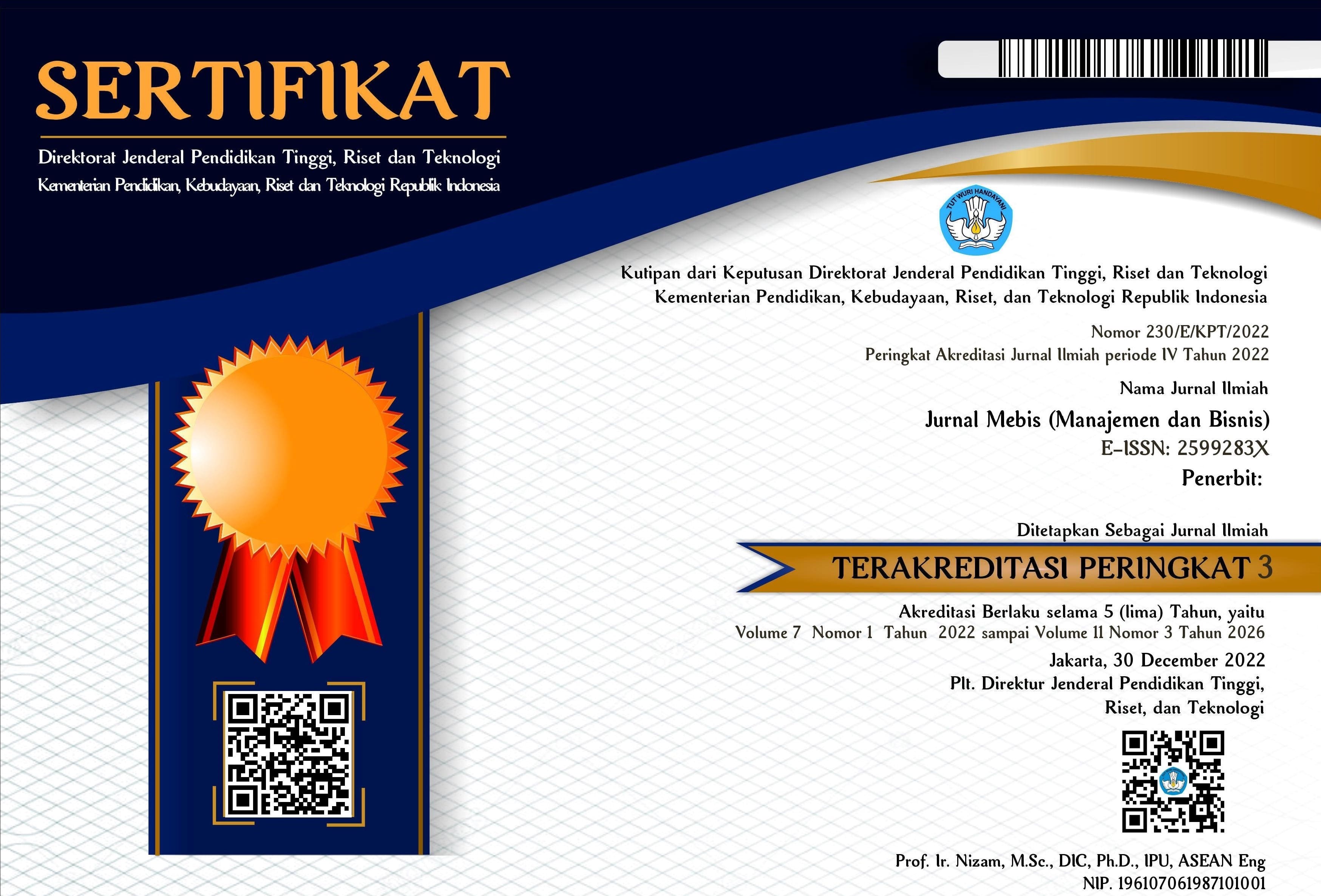
Financial Behaviour and Stock Investment Decisions: Exploring the Role of Dual Process Theory Among Generation Z In East Java
DOI:
https://doi.org/10.33005/mebis.v11i1.769Keywords:
Financial Behavior, Loss Aversion, Investment Decision, Herding BehaviorAbstract
This study examines the influence of financial behaviour, including fear of missing out, financial literacy, herding behaviour, loss aversion, and risk perception, on stock investment decisions among Generation Z in East Java. Utilizing Dual Process Theory as a theoretical framework, this research explores the dynamic interaction between intuitive and analytical thinking processes in shaping investment behaviour. A quantitative approach was employed, with data collected through questionnaires with a Likert scale of 1-5, distributed to 402 Generation Z respondents actively investing in the stock market. Data were analysed using SEM-PLS with SmartPLS 3.3. The results reveal that financial literacy positively impacts herding behaviour and loss aversion, while herding behaviour and loss aversion significantly influence investment decisions. Moreover, fear of missing out and risk perception serve as critical intermediaries, illustrating how emotional and cognitive factors interact in decision making. The findings contribute to a deeper understanding of Generation Z’s investment behaviour, highlighting the significance of balancing intuition and analysis. Practical implications include the need for targeted financial education programs to enhance financial literacy and reduce bias-driven behaviour. This study provides theoretical insights by bridging the dual process theory with financial decision-making, offering a comprehensive framework for understanding stock investment behaviour in emerging markets. Future research could expand this scope by exploring other demographic groups or incorporating additional psychological factors.
Downloads
References
Abel, J. P., Buff, C. L., & Burr, S. A. (2016). Social media and the fear of missing out: Scale development and assessment. Journal of Business & Economics Research, 14(1).
Ainia, N. S. N., & Lutfi, L. (2019). The influence of risk perception, risk tolerance, overconfidence, and loss aversion towards investment decision making. Journal of Economics, Business, & Accountancy Ventura, 21(3), 401–413.
Ardelia, S. S., Ulupi, I. G. K. A., & Gurendrawati, E. (2025). The Role of Fear of Missing Out (FoMO) in Herding Behaviour and Overconfidence on Generation Z’s Investment Decisions. International Journal of Current Economics & Business Ventures, 5(1).
Aren, S., & Zengin, A. N. (2016). Influence of financial literacy and risk perception on choice of investment. Procedia-Social and Behavioural Sciences, 235(235), 656–663.
Asset Management Market 360iResearch. (2024). Crypto asset management market by deployment (On-cloud, on-premise), end-user (banking, financial services & insurance (BFSI), brokerage firms, hedge funds) - Global forecast 2024-2030. ASD Reports. https://www.asdreports.com/market-research-report-646672/crypto-asset-management-global-forecast
Baker, H. K., Kumar, S., Goyal, N., & Gaur, V. (2019a). How financial literacy and demographic variables relate to behavioural biases. Managerial Finance, 45(1), 124–146.
Baker, H. K., Kumar, S., Goyal, N., & Gaur, V. (2019b). How financial literacy and demographic variables relate to behavioural biases. Managerial Finance, 45(1), 124–146.
Blumberg, B., Cooper, D., & Schindler, P. (2014). EBOOK: Business research methods. McGraw Hill.
Bougie, R., & Sekaran, U. (2019). Research methods for business: A skill building approach. John Wiley & Sons.
BPS East Java Province. (2022). Development of some key social economic indicators East Java 2022. BPS East Java Province. https://jatim.bps.go.id/en/publication/2022/11/03/f6dbdd1b0620f8049654474b/development-of-some-key-social-economic-indicators-east-java-2022.htm
Budiman, J., Ong, T., & Yuwono, W. (2025). Exploring Cognitive Bias Influence on Investment Decisions in Indonesia: The Mediating Role of FOMO. Jurnal Economia, 21(3), 432–446.
Dar, F. A., & Hakeem, I. A. (2015). The influence of behavioural factors on investors investment decisions: A conceptual model. International Journal of Research in Economics and Social Sciences, 5(10), 51–65.
Dewan, P., & Dharni, K. (2019). Herding behaviour in investment decision making: a review. Journal of Economics, Management and Trade, 24(2), 1–12.
Eniola, A. A., Entebang, H., & Sakariyau, O. B. (2015). Small and medium scale business performance in Nigeria: Challenges faced from an intellectual capital perspective.
Febianti, V., & Simatupang, F. S. (2025). Gen Z dan Keputusan Investasi: Pengaruh Overconfidence, Regret Aversion, dan Loss Aversion di Kota Cimahi. Jurnal Administrasi Bisnis (JAB), 15(1), 1–10.
Garduno, J. C. (2022). Financial Advisor Decisions and Behavioural Biases. California Baptist University.
Gherghina, Ștefan-C., & Constantinescu, C.-A. (2024). Examining herding behaviour in the cryptocurrency market. Equilibrium. Quarterly Journal of Economics and Economic Policy, 19(3), 749–792.
Ghozali, I., & Latan, H. (2015). Partial Least Squares : Konsep, Teknik dan Aplikasi Menggunakan Program SmartPLS 3.0 Untuk Penelitian Empiris. Badan Penerbit Undip.
Goodfellow, C., Bohl, M. T., & Gebka, B. (2009). Together we invest? Individual and institutional investors’ trading behaviour in Poland. International Review of Financial Analysis, 18(4), 212–221.
Gupta, S., & Shrivastava, M. (2023). Behavioural finance: A critical literature review using Pareto analysis. Thailand and the World Economy, 41(2), 156–183.
Humairo, A., & Panuntun, B. (2022). Perilaku Overconfidence, Loss Aversion, dan Herding Bias dalam Pengambilan Keputusan Investasi Pasar Modal pada Generasi Z. Selekta Manajemen: Jurnal Mahasiswa Bisnis & Manajemen, 1(6), 213–226.
Idris, H. (2024). The Effects of FOMO on Investment Behaviour in the Stock Market. Golden Ratio of Data in Summary, 4(2), 879–887.
Jajoo, K., & Kumar Baag, P. (2025). The Role of Fomo (Fear of Missing Out) in Making Financial Decisions.
Jowey, G. F. M., Ferli, O., Wijaya, E., & Haryanti, E. (2024). Influence Herding and Loss Aversion to Stock Investment Decisions with Fear of Missing Out (FOMO) as a Mediating Variable in the Young Generation in Jakarta. Greenation International Journal of Economics and Accounting, 2(2), 189–201.
Kang, I., & Ma, I. (2020). A study on bandwagon consumption behaviour based on fear of missing out and product characteristics. Sustainability, 12(6), 2441.
Kaur, M., Jain, J., & Sood, K. (2024). “All are investing in Crypto, I fear of being missed out”: examining the influence of herding, loss aversion, and overconfidence in the cryptocurrency market with the mediating effect of FOMO. Quality & Quantity, 58(3), 2237–2263.
Kuchler, T., & Stroebel, J. (2021). Social finance. Annual Review of Financial Economics, 13(1), 37–55.
Lusardi, A. (2019). Financial literacy and the need for financial education: evidence and implications. Swiss Journal of Economics and Statistics, 155(1), 1–8.
Mariotti, S., Marzano, R., & Piscitello, L. (2022). Reinvest or not reinvest in the host country? Learning from past divestments to plan future actions. In Research Handbook on Foreign Exit, Relocation and Re-entry (pp. 344–369). Edward Elgar Publishing.
Meyer, J., Friederich, F., Matute, J., & Schwarz, M. (2024). My money—My problem: How fear‐of‐missing‐out appeals can hinder sustainable investment decisions. Psychology & Marketing, 41(11), 2677–2694.
Modzelewski, P. (2020). Fomo (fear of missing out)–an educational and behavioural problem in times of new communication forms. Konteksty Pedagogiczne, 14(1), 215–232.
Monicah, C., & Shiundu, V. (2020). Investor Behaviour and Common Stock Investment Decisions among Individual Investor at Nairobi Securities Exchange, Kenya. International Academic Journal of Economics and Finance, 3(6), 18–31.
Nguyen, T. T. H., Pham, P. T., Pham, T. A., Ly, T. V., Nguyen, T. L., & Pham, T. H. Y. (2024). Herding in the Digital Era: Social Media’s Impact on Personal Investor Decisions Using the 4A Framework. 21st Asian Academic Accounting Association Annual Conference.
PT Kustodian Sentral Efek Indonesia. (2020, October 27). Jumlah investor pasar modal terus bertambah. Media Asuransi News. https://mediaasuransinews.co.id/news-in-brief/jumlah-investor-pasar-modal-terus-bertambah
Putri, R. A., & Isbanah, Y. (2020). Faktor-faktor yang mempengaruhi keputusan investasi pada investor saham di Surabaya. Jurnal Ilmu Manajemen (JIM), 8(1).
Rahmawati, U., & Raharja, S. (2024). The Influence of Herding, Loss Aversion, And Availability on Investment Decision-Making with Fear of Missing Out as a Mediating Variable Among Generation Z Investors. Indonesian Interdisciplinary Journal of Sharia Economics (IIJSE), 7(3), 8461–8482.
Rasool, N., & Ullah, S. (2020). Financial literacy and behavioural biases of individual investors: empirical evidence of Pakistan stock exchange. Journal of Economics, Finance and Administrative Science, 25(50), 261–278.
Rozgonjuk, D., Sindermann, C., Elhai, J. D., & Montag, C. (2021). Individual differences in Fear of Missing Out (FoMO): Age, gender, and the Big Five personality trait domains, facets, and items. Personality and Individual Differences, 171, 110546.
Suresh G. (2021). Impact of Financial Literacy and Behavioural Biases on Investment Decision-making. FIIB Business Review. https://doi.org/10.1177/23197145211035481
Suresh, G. (2024). Impact of financial literacy and behavioural biases on investment decision-making. FIIB Business Review, 13(1), 72–86.
Toma, S.-V., Chiriţă, M., & Şarpe, D. (2012). Risk and uncertainty. Procedia Economics and Finance, 3, 975–980.
Xiao, J. J., & Porto, N. (2017). Financial education and financial satisfaction: Financial literacy, behaviour, and capability as mediators. International Journal of Bank Marketing, 35(5), 805–817.
Yeo, K. H. K. (2024). Understanding Financial Planning Behaviour: Insights from Theory of Planned Behaviour for Financial Planning (Doctoral dissertation, Swinburne).
Yong, C.-C., Yew, S.-Y., & Wee, C.-K. (2018). Financial knowledge, attitude and behaviour of young working adults in Malaysia. Institutions and Economies, 10(4).